Professional maintenance guide for yacht marinas: Hengqiao Marine Engineering has been ensuring safe operations for 20 years. These precautions must be firmly remembered!
As the core carrier of high-end water facilities, yacht marinas can have a normal service life of up to 20 years. However, when exposed to complex environments such as wind, sun, wave impact, and salt corrosion for a long time, without scientific maintenance and standardized operation, it will not only shorten the service life and reduce the ability to resist typhoons but also potentially pose safety hazards. To help marina owners/operators build a solid safety defense line and extend the service life of facilities, Guangzhou Hengqiao Marine Engineering Co., Ltd., leveraging over ten years of industry experience, has compiled professional maintenance guidelines and core considerations. Furthermore, with full-process maintenance services, we will safeguard your water assets!
1. Regular inspection: Build a solid first line of defense for safety (These details must not be ignored)
Regular inspection is the core of dock maintenance, which should be carried out periodically and with focus. At the same time, the following precautions should be kept in mind:
1. Core structural components: 2 professional inspections per year (ideally in May and December)
Steel structure/aluminum structure: Precautions: Avoid scratching the anti-corrosion coating with hard objects. If rust spots are found, they should be polished and repainted in a timely manner. If cracks or deformations appear at the welding junction, immediately stop using it and contact a professional for repair. It is strictly prohibited to weld and reinforce it yourself. Screws need to be checked one by one, especially those parts that have been immersed in water for a long time. They should be maintained with rust preventatives to prevent the screws from rusting and getting stuck.
Coastal connection part: Precautions: The measurement frequency should be at least once every quarter. In case of severe weather such as rainstorms and typhoons, additional measurements should be conducted. If the settlement displacement exceeds 5cm, immediately limit the dock load to avoid personnel and yacht docking.
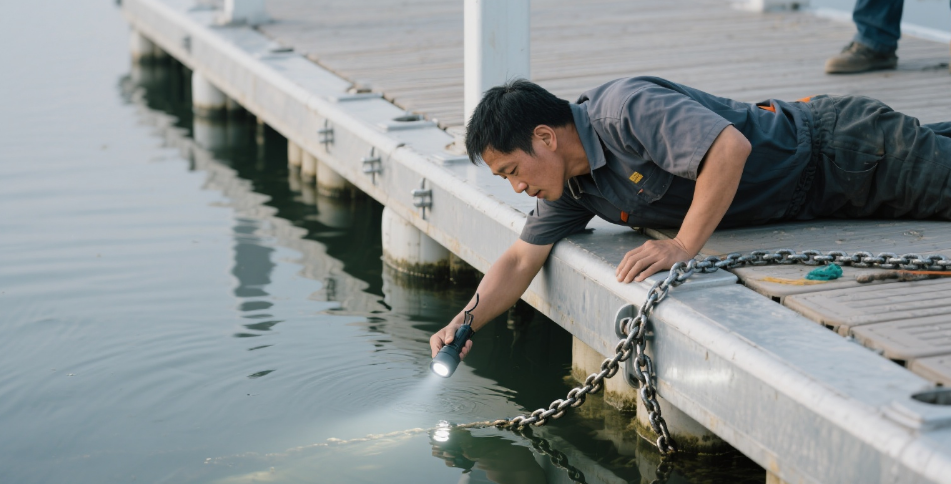
Underwater anchor block: Precautions: During inspection, ensure that the water surface is calm and avoid working in windy and wavy weather; if the anchor rope shows signs of wear or broken wires, even if it is not completely broken, it must be replaced promptly to prevent sudden breakage that could cause the dock to drift.
2. Auxiliary facilities: Conduct routine inspections monthly, and replace any damaged ones immediately (these taboos should be avoided)
Facility type Inspection focus Handling method Core considerations
If the buoyancy tank is damaged, flooded, or sinking, it must be replaced immediately. It is prohibited to repair damaged buoyancy tanks with ordinary glue. Professional waterproof and anti-corrosion materials must be used. After replacement, the buoyancy must be tested to ensure it meets the load-bearing standards
If the panel is cracked, damaged, or has reduced anti-slip performance, it should be replaced promptly. Avoid stacking heavy or sharp objects on the panel; when replacing the panel, it is necessary to use anti-slip and anti-corrosion materials of the same specification to ensure a level installation without height differences
Fender deformation, damage, and exposed bolts require repair or replacement. The fender must be kept neat and tidy, and random disassembly is prohibited. If exposed bolts or sharp iron parts are found on the upstream face of the dock, they should be immediately polished or fitted with protective covers to prevent scratching yachts
Bollard: Looseness, overload. Fasten and reinforce. Strictly use it according to the specified load, and prohibit overloading mooring; when tightening the screws, use tools of corresponding specifications to avoid damaging the threads due to excessive force
Screw accessories that are missing, loose, rusted, or worn should be replenished and tightened. Screws should be made of corrosion-resistant materials such as stainless steel, and any missing ones should be promptly matched and replaced. If the rust or wear exceeds 10% of the thickness of the column arm, the entire part must be replaced, and it is prohibited to use it in a makeshift manner
3. Supporting facilities: Conduct regular inspections to ensure functionality (these details are often overlooked)
Inspect onshore fire-fighting equipment, warning lights, water and electricity boxes, ladders, etc. Precautions: Fire-fighting equipment needs regular annual inspection to ensure that fire extinguishers are at normal pressure and water pipes are not damaged; warning lights need to be tested monthly for lighting conditions to avoid failure to warn at night due to aging circuits; water and electricity boxes need to be properly sealed to prevent water ingress and short circuits, and the dust and debris inside the boxes should be regularly cleaned.
II. Coping with severe weather: Take precautions in advance to avoid significant damage (These operations must be standardized)
In the face of extreme weather conditions such as strong winds, high waves, and freezing temperatures that exceed the wharf's bearing capacity, it is necessary to prepare for dismantling and protection in advance, while keeping the following precautions in mind:
Before dismantling, it is necessary to check the weather forecast in advance and reserve sufficient time to complete the operation, avoiding hasty dismantling in a rainstorm or strong wind;
The demolition sequence must strictly follow the order of "side roads → main roads → pedestrian stairs", and reversing the order is prohibited to prevent structural collapse;
All connecting pieces should be stored according to their classification and number to avoid confusion. The storage environment should be dry and ventilated to prevent rust and corrosion;
After being unloaded from the dock, they must be placed flat and stacked or tilted is prohibited. When covered with tarpaulins, they must be completely sealed to prevent moisture from infiltrating;
If dismantling cannot be carried out in a timely manner due to sudden severe weather, immediately cut off the water and electricity supply at the dock, evacuate all personnel, and prohibit any ships from docking.
⚠️ Special reminder:
When the wave height exceeds 1.0 meters, it is strictly prohibited for business use, and personnel must be immediately organized to dismantle and transport it to a safe location;
Arrange specially-assigned personnel to guard the dock 24 hours a day, especially during flood seasons and typhoon seasons, when patrols need to be conducted every 2 hours. In case of major issues, contact a professional team for immediate handling;
Non-professionals are prohibited from dismantling and repairing the core structure of the dock without authorization, to avoid secondary damage caused by improper operation.
III. Daily use and maintenance: These habits can extend the lifespan of the dock
To avoid high-speed collisions with the dock fender, slow down when docking, and use soft-material mooring ropes to reduce wear on the bollards and fender;
Regularly clean the oil and garbage on the surface of the dock to prevent corrosive substances from adhering for extended periods. When cleaning, avoid using strong acid or alkali cleaners and opt for neutral, environmentally friendly cleaners instead;
Welding, cutting, and other operations involving open flames are prohibited on the dock. If construction is necessary, fire prevention measures must be taken in advance, and fire-fighting equipment must be equipped;
In case of freezing weather in winter, the ice layer on the surface of the dock should be removed in time to avoid structural cracking caused by ice expansion; during high temperatures in summer, water can be sprayed on the surface of the steel structure to cool it down, reducing the impact of thermal expansion and contraction on the structure.
IV. Leave professional matters to professionals: Hengqiao Marine Engineering's maintenance services ensure your peace of mind
Yacht marina maintenance involves professional knowledge such as structural mechanics, anti-corrosion technology, and hydraulic environment. Non-professional operations may backfire. Guangzhou Hengqiao Marine Engineering Co., Ltd., as a senior service provider in the field of water engineering, will escort your marina with professional strength:
Senior Team: Our core technical staff boasts over ten years of professional experience, specializing in the maintenance and repair of various facilities such as steel structures, aluminum structures, and floating docks;
Professional services: We provide comprehensive services for dock repair, maintenance, upgrading, and renovation, covering everything from regular inspections to emergency repairs, and from anti-corrosion treatment to structural optimization. We offer a one-stop solution for all your needs;
Rich cases: Foshan Fishery Administration Wharf Construction, Cambodia Wharf Export, Guangzhou Haizhu Lake Trestle, Sanya Aluminum Alloy Approach Bridge Construction, Huizhou Wharf Maintenance, Guangzhou Taikoo Warehouse Wharf Maintenance and Upgrade, and many other successful projects, witnessing professional strength;
Industry reputation: With standardized service processes, excellent technical skills, and attentive after-sales support, we have established a good reputation in the industry and become the trusted choice of many terminal owners.
Protect the safety of the dock, extend its service life, and ensure peace of mind for every berthing! If you have any needs for yacht dock maintenance, repair, or upgrade, please feel free to contact us. Hengqiao Marine Engineering will be happy to serve you!
Consultation hotline: 13660108188 Company address: Contact information: 13660108188 Company address: Room 1014, No. 2, Huijing West Second Street, Huadu District, Guangzhou
 ∷
∷




 广州市恒桥海上工程有限公司